When the Problem Isn't the Problem
PERSPECTIVE 06
When the Problem Isn't the Problem
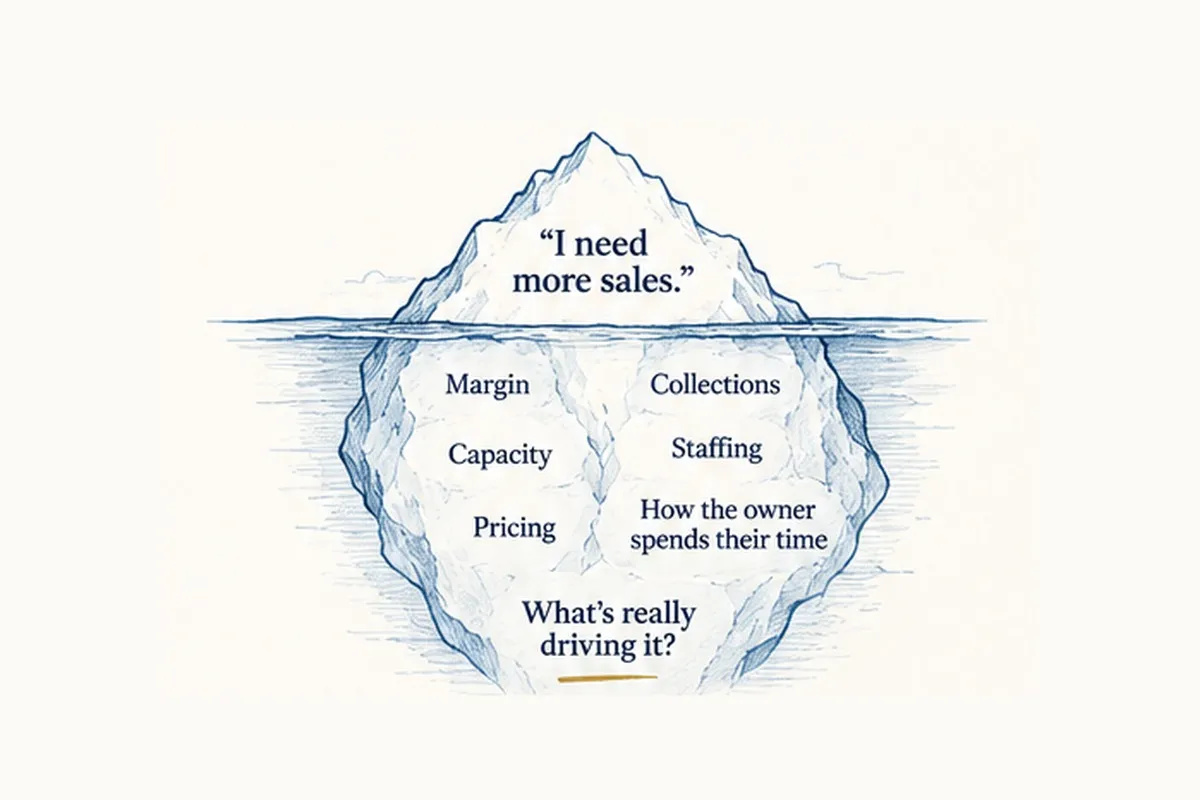
What's really driving it?
"I need more sales."
I've heard some version of this from business owners more times than I can count.
It sounds straightforward. More sales should solve it, right? But often, when we begin looking more closely at the business, sales aren't really the problem.
Revenue may be growing, but margins are shrinking.
The calendar may be full, but the team doesn't have the capacity to handle more work.
Customers are buying, but invoices aren't being collected quickly enough to support cash flow.
Prices haven't kept pace with the cost of delivering the work.
Or the owner is so deeply involved in the day-to-day that there simply isn't enough time to lead, develop the team, or think about where the business is going.
In each case, more sales might actually make the problem bigger.
That's the part that can be difficult to see when you're inside the business every day.
You experience the symptom.
Cash feels tight.
The team feels overwhelmed.
Profit isn't where you expected it to be.
You're working harder, but don't feel as though you're getting ahead.
So naturally, you look for the thing that appears most likely to fix it.
More sales.
Another employee.
A price increase.
New software.
A marketing campaign.
But businesses are interconnected.
Changing one thing almost always affects something else.
Before solving the problem we can see, sometimes we need to understand what is creating it.
That means looking beneath the surface.
Following the numbers.
Understanding how the work actually moves through the business.
Looking at capacity, pricing, margins, cash flow, people, processes, and even how the owner's own time is being spent.
Not because every business needs to be analyzed endlessly.
But because solving the wrong problem can consume time, money, and energy while leaving the real issue untouched.
And sometimes, it makes it worse.
"The problem you can see isn't always the problem you need to solve."
Sometimes the most valuable question isn't:
"How do I fix this?"
It's:
"What is really causing this?"